Blog
This virtual Library is an online repository that provides digital access to collections, and user interfaces that allow discovery, reading, and possibly download. It does not require physical presence at an archive. Its purpose is to make rare, fragile material accessible globally while preserving originals.
In today’s fast-paced digital world, accessing knowledge should not come with limits and that is exactly what our virtual library offers. With just a few clicks, you can browse some available rare newspapers in Ghana. Start exploring today and discover how our virtual library brings joy of reading and learning straight your screen.
The Liberator
This newspaper was also known as the voice of opposition in Gold Coast (GHANA). In mid-September 1955, the National Liberation Movement (NLM) a political party broke away from the Convention People’s Party (CPP). The press in Gold Coast at that time was intensely neutral conveyors of news; they were active participants in shaping public opinion, mobilizing support, and attacking rival parties.
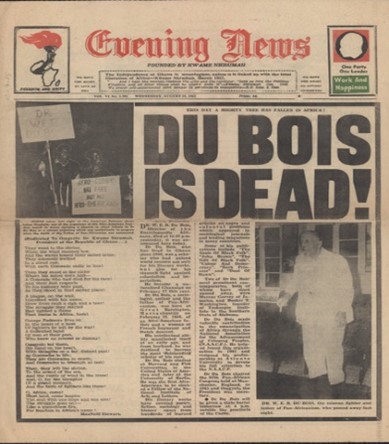
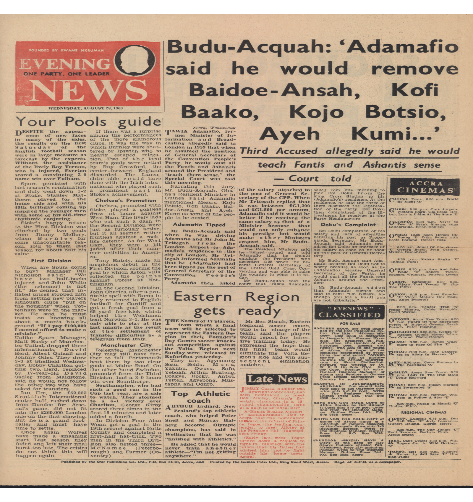
The Accra Evening News paper

Also known as, voice of independence was founded by Dr. Kwame Nkrumah on 3 September 1948, and it was a powerful tool in Ghana’s struggle for freedom and self-government. It operated as the mouthpiece of the Convention People’s Party (CPP). It served as a precedent for more politically engaged journalism.
The Spectator
The Spectator was a moderate, English-language weekly newspaper that served as a social and cultural voice during the colonial period. It reflected both colonial values and the growing African demand for political change, helping shape public discourse during Ghana’s journey to independence. It covered local and international events, sometimes cautiously addressing political unrest or rising nationalist sentiments. It covered of key events, like the 1948 Accra Riots, the arrest of the Big Six, and the formation of political parties like the UGCC and CPP.
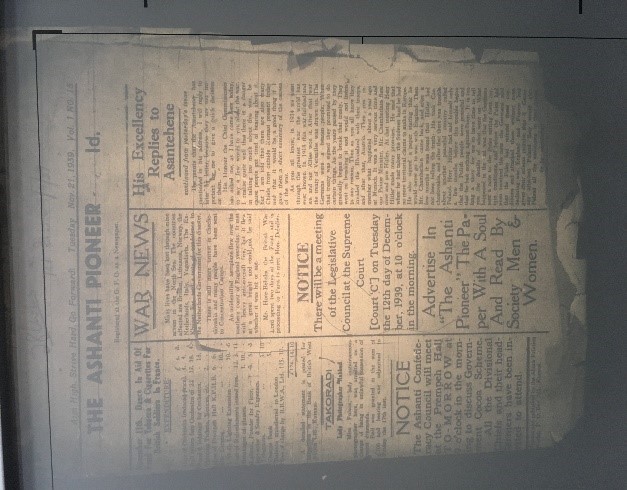
The Ashanti Pioneer
This newspaper was also known as the voice of the nation in waiting. It was founded in 1939 and published in Kumasi. The Ashanti Pioneer carved a bold path by highlighting African perspectives on governance, tradition, and social change. With its roots deep in Ashanti land, it was one of the first indigenous newspapers to gain widespread credibility and readership beyond its region. The paper served as a forum for local voices, reporting on developments not just in Accra but in Kumasi, Obuasi, Sunyani, and other parts of the interior — areas often underrepresented in the coastal-dominated colonial press.
The Royal Gold Coast Gazette and Commercial Intelligencer
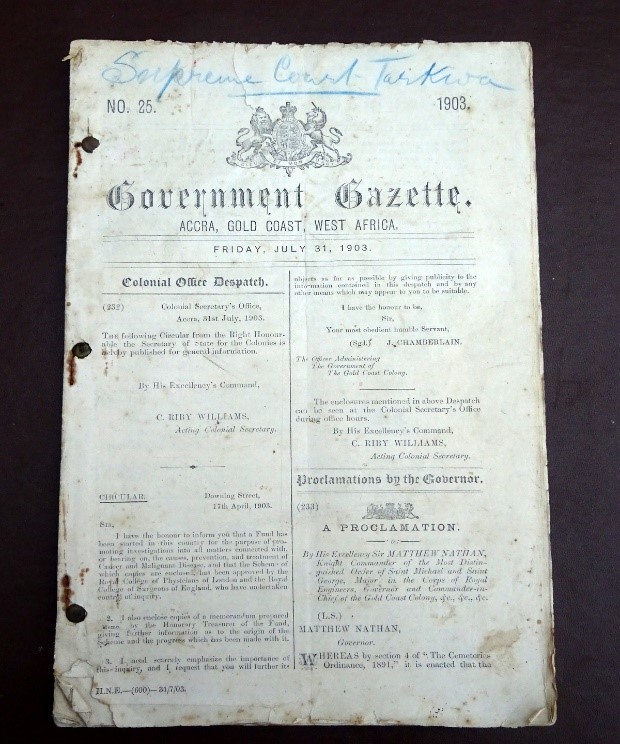
In the annals of West African print history, the Royal Gold Coast Gazette & Commercial Intelligencer holds a special place. Launched in April 1822 in Cape Coast, it is widely recognized as the first newspaper in what was then the British Gold Coast (now Ghana). This gazette was handwritten each copy transcribed manually reflecting both technological limits and the small literate audience of colonial officials, settlers, and merchants. Its symbolic and practical significance endured. It marked the beginning of a print tradition in the Gold Coast, one that would later evolve into a more robust, localized press — with newspapers owned and run by Africans, advocating for social and political change.
The Daily Graphic

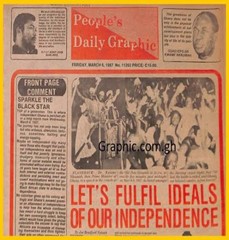
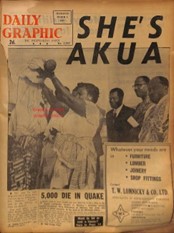
The Graphic Communications Group Ltd (GCGL) was established in the then Gold Coast in 1950, originally as the West African Graphic Company Limited, under the British Daily Mirror Group. Its first publication under that company was Daily Graphic, launched on 2 October 1950. Over time, Daily Graphic has become one of Ghana’s leading English‑language newspapers, with widespread circulation and influence in national discourse.

It played a role during Ghana’s transition to independence, as the media environment in the Gold Coast/Ghana often intersected with nationalist movements. As media ownership and nationalization shifted post-independence, the Graphic Group itself was sold to the Ghanaian government in 1960s. In the 21st century, the Daily Graphic has continued to evolve. While its print edition remains popular, especially among older demographics and rural readers, the newspaper has embraced digital transformation. The Daily Graphic is more than just the history of a newspaper it is the story of modern Ghana itself. Born in the twilight of colonialism and growing through independence and beyond, it reflects the triumphs and tensions of Ghanaian society.
Western Echo
The Western Echo was a fortnightly newspaper published in Cape Coast, Ghana, from November 1885 to December 1887. The publication succeeded the Gold Coast Times, which ceased publication in August 1885. The newspaper played a significant role in the development of Ghanaian journalism, particularly in the late 19th century. It exemplified the emergence of a locally driven press that was not only a platform for news but also a vehicle for political expression and advocacy. Joseph Ephraim Casely-Hayford, a prominent lawyer and journalist, and Timothy E. Laing, an ordained Methodist minister, founded it.
West African Monitor
It was a newspaper published in Ghana. It was part of the vibrant press scene in West Africa, serving as a source of news, opinions, and information during its time. It covered regional news across West Africa, including Ghana, Nigeria, Sierra Leone, and other neighboring countries. Focused on political developments, social issues, and economic affairs relevant to West African countries. The West African Monitor operated mainly during the mid-20th century, a critical period when many West African nations were moving toward independence. It was founded in 1948 and stopped publication in 1953.